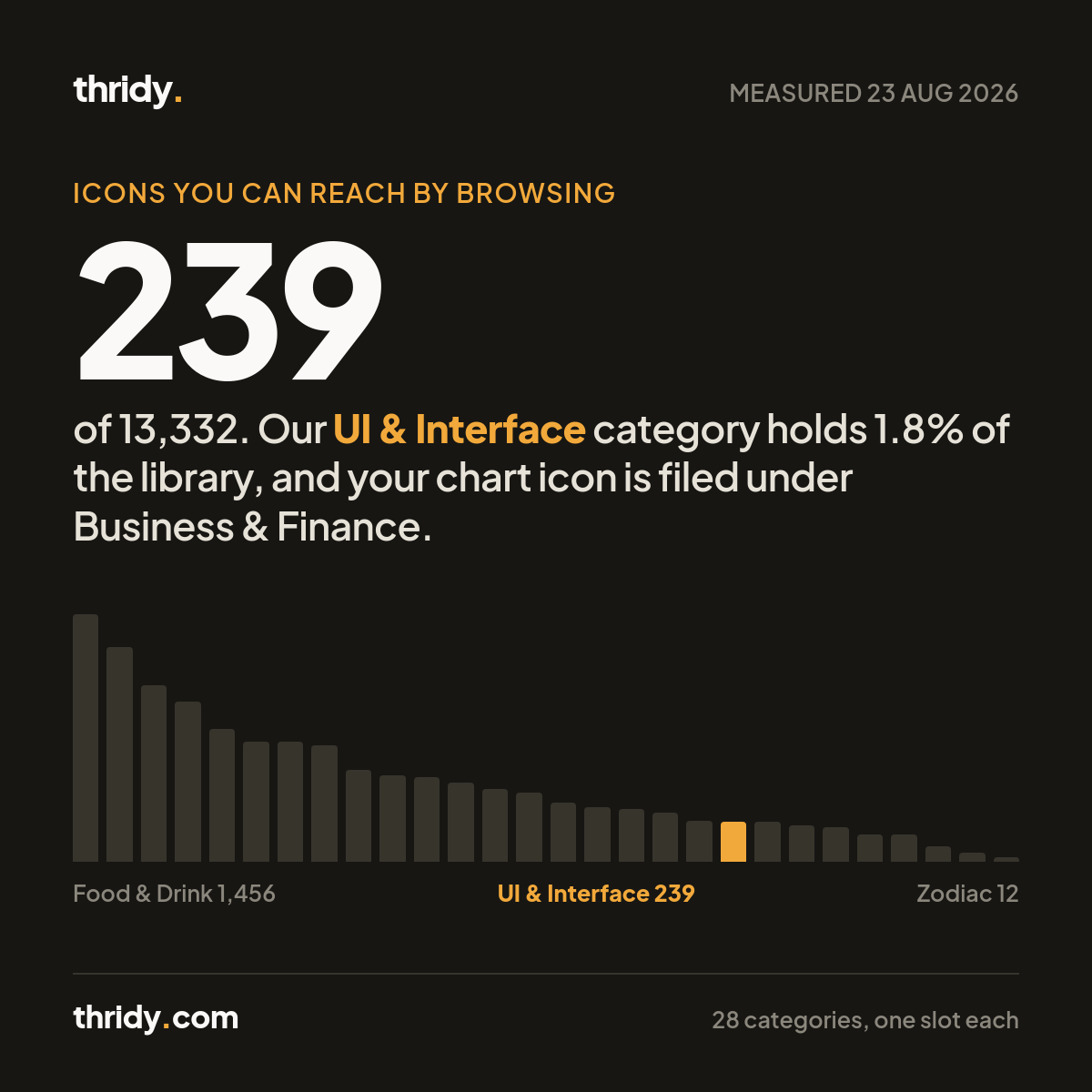
If you came to Thridy to fit out a product interface, you probably clicked UI & Interface first. It is the obvious door. You got 239 icons, and among them were a bomb, an oil rig, a Minolta camera and a Celtic cross. The reasonable conclusion is that this library is not built for product work.
That conclusion is wrong, and the fault is ours. We spent today crawling our own category tree and measuring what browsing it actually returns. We hold 13,332 icons. Each one is filed under 2.31 categories on average. The category pages only ever read one of them. The icons you came for exist, and they are shelved under what they are rather than under what you would use them for.
What a category page actually asks for
Every category page is a call to api.thridy.com/api/icons with a category parameter, and the response carries a total. So we asked for all 28 categories one at a time and added the totals up. Food & Drink is our largest at 1,456 icons, 10.9% of the library. Then Animals at 1,265 and Transportation at 1,033. UI & Interface sits at 239, which is 1.79%. The smallest is Zodiac, with 12.
The 28 totals sum to exactly 13,332, the size of the whole library. That number is the finding, not a formality. If the filter looked at every category an icon carries, the sum would overshoot the library size, because icons carrying two or three categories would be counted twice or three times. It lands exactly on 13,332, which means each icon is counted once, which means the filter reads one field and ignores the rest.
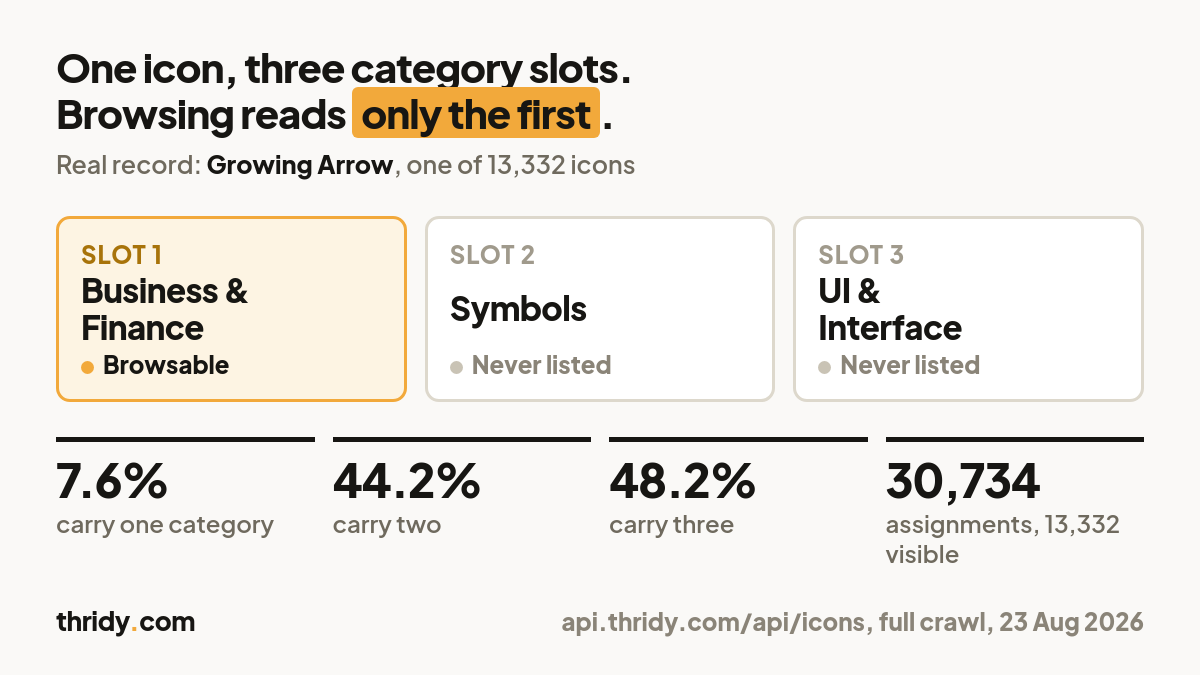
Every icon carries 2.31 categories and you see one
We then pulled the full library, all 13,332 records over 27 pages, and looked at the three category slots on each one. Only 7.6% of icons carry a single category. 44.2% carry two and 48.2% carry three. Across the library that is 30,734 distinct category assignments, of which 13,332 are ever reachable by browsing. The other 17,402 are metadata that nothing in the interface surfaces.
We checked this rather than assuming it. 35 icons carry UI & Interface in their second or third slot but not their first. Brokerage, Color Palette, File Transfer, Code Image, Growing Arrow. We requested the full UI & Interface listing, all 239 of them, and compared. Not one of those 35 appears. Browsing our UI category shows 239 icons when 274 are tagged for it.
The same gap is far wider elsewhere. Objects is the primary category for 708 icons, but 6,221 icons carry Objects somewhere, which is 46.7% of everything we make. 5,513 of them are invisible to anyone browsing that shelf.
The tree sorts by what a thing is, not what it is for
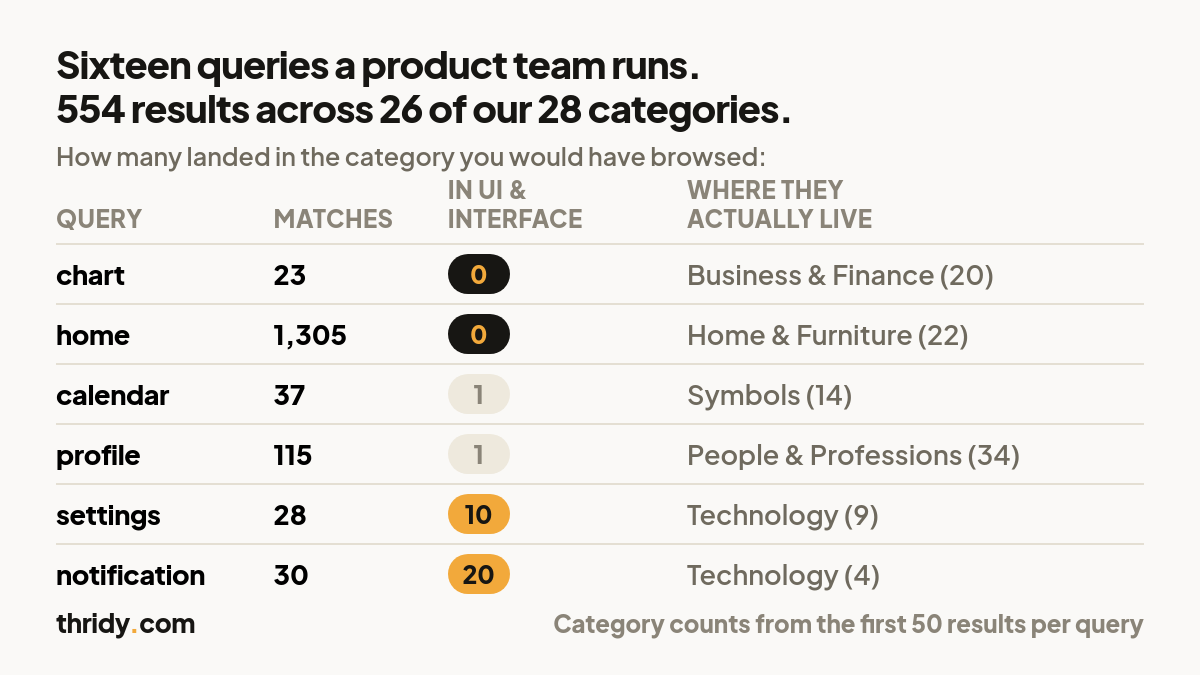
We picked 16 words a product team actually types when building a dashboard: settings, search, notification, calendar, upload, download, filter, share, trash, edit, lock, profile, chart, message, home, cart. We ran each through search and looked at where the results are filed. 554 results came back across 26 of our 28 categories. Only 12.5% of them sit primarily in UI & Interface.
Some queries are worse than others. Search for chart and you get 23 icons, and zero of them are in UI & Interface. 20 are in Business & Finance. Search for home and you get 1,305 matches, of which the first 50 include 22 in Home & Furniture and none in UI & Interface. Calendar returns 37, one of which is a UI icon and 14 of which are Symbols. Profile returns 115, and 34 of the first 50 are People & Professions.
Browsing is not useless everywhere. Notification returns 30 icons and 20 of them are in UI & Interface. Settings returns 28 with 10 there. Those are concepts that have no physical referent, so the only sensible shelf is the interface one. The moment a concept has a real world object attached, a calendar, a house, a shopping cart, a chart, the object wins the primary slot and the interface use gets pushed into slot two or three where nothing reads it.
Bar Chart, Calendar and Charts are all Business & Finance
Three concrete examples, each fetched to confirm the file is real and not just a stale row in a table. Bar Chart is 19,748 bytes as WebP on our CDN. Calendar is 25,184 bytes. Charts is 31,138 bytes. All three returned HTTP 200. All three are filed primarily under Business & Finance. If you evaluated Thridy by opening UI & Interface, you concluded we had no chart icon and no calendar icon, and you were looking at the wrong shelf.
Keywords carry intent, categories carry subject
Search finds these icons because it reads a different field. Every icon in the library has keywords, between 5 and 10 of them, 8.2 on average, and not one of the 13,332 has an empty keyword list. Those keywords are where use case language lives. 1,154 icons mention UI or interface in their keywords, against the 274 that carry the category. That is 4.2 times more coverage in a field browsing does not touch.
One honest caveat, because the same measurement exposes a flaw of ours. Search matches keywords, so boilerplate inflates it. Search download and you get 999 results, which looks like a deep shelf of download icons. Exactly one icon in the library has download in its name. 999 have it as a keyword because our descriptions and keyword lists say free to download, a phrase that appears in 84.6% of our descriptions. A large result count is not the same as a large set of relevant icons, and you should read the first screen before you trust the number.
What to do instead
Search the object, not the job. If you need a chart icon, type chart, not analytics or dashboard. Our keywords describe the thing in the render, and so does the name. Jakob Nielsen reported back in 1997 that more than half of users go straight to search and about a fifth navigate by links, which matches what our own numbers say you should do here.
Treat category as a filter you apply after searching, not a shelf you browse first. Browsing gives you 1.79% of the library and mixes in an oil rig. Searching gives you results spanning 26 categories, which is where your set actually is.
And when you evaluate any icon library, including ours, do not judge coverage by the size of its interface category. Judge it by running your real icon list through search and counting the misses. We wrote up what happened when we did exactly that in We Searched Our Own 13,315 Icons for 30 Product Words, and thirteen of them came back empty.
What we are changing
Three things, in the order we can ship them. The category filter should match any of the three slots rather than the first, which turns UI & Interface from 239 icons into 274 and Objects from 708 into 6,221. That is a one line change to a query and it is the whole of this article's value.
Second, 1,335 icons, a full 10.0% of the library, repeat the same category in two slots. Acoustic Guitar is Music, Music, blank. Abandoned House is Places & Architecture twice, then Objects. Those icons paid for a second classification and got nothing, and fixing them widens coverage before we add a single new render.
Third, the keyword boilerplate. Free to download in 84.6% of descriptions is noise that makes our own search totals untrustworthy, and it needs to come out of the indexed fields.
How we measured this
Everything above came from our public API on 23 August 2026, and you can rerun it. The category list came from api.thridy.com/api/categories. The per category totals came from api.thridy.com/api/icons with limit=1 and a category parameter, reading the total field. The full library came from the same endpoint at limit=500 across 27 pages, which returned 13,332 unique records with no duplicates between pages. The search figures came from limit=50 requests, so any query with more than 50 matches is described here by its first 50 results and we have said so where that applies. The three file sizes are content-length headers from cdn.thridy.com. If you get different numbers, we have shipped icons since, and the shape of the finding will still hold.
Free 3D icons for this
Every icon on Thridy is free to download and use. A few that fit this piece:
- Red Rocket 3D icon
- Percentage 3D icon
- Lint Remover 3D icon
- Mango Shaved Ice 3D icon
- Snow Cone Machine 3D icon
- Shaved Ice 3D icon
Browse all 2,600+ free 3D icons or explore them by category.